W&B Weave observability for ADK
W&B Weave traces ADK agent invocations, sub-agent handoffs, model calls, and tool calls. Weave groups the resulting traces by agent and conversation in the Agents view so you can inspect an agent's behavior, latency, token usage, and cost.
Prerequisites
- A W&B account and API key
- A Google API key for Gemini
Set the credentials in your environment:
export WANDB_API_KEY=<your-wandb-api-key>
export GOOGLE_API_KEY=<your-google-api-key>
export GEMINI_API_KEY=<your-google-api-key>
Python ADK reads GOOGLE_API_KEY. The TypeScript example below reads
GEMINI_API_KEY.
Install dependencies
Trace an ADK agent
Initialize Weave with your W&B team and project, then create and run your ADK agent normally.
The Python SDK detects ADK when weave.init() runs and patches it for
tracing. Import ADK before initializing Weave, as shown here.
import asyncio

import weave
from google.adk.agents import Agent
from google.adk.runners import InMemoryRunner
from google.genai import types


weave.init("<your-team>/<your-project>")


def add(a: float, b: float) -> dict[str, float]:
    """Add two numbers."""
    return {"total": a + b}


root_agent = Agent(
    name="calculator_agent",
    model="gemini-2.5-flash",
    instruction="Use the add tool to answer arithmetic questions.",
    tools=[add],
)


async def main() -> None:
    runner = InMemoryRunner(
        agent=root_agent,
        app_name="weave-adk-example",
    )
    session = await runner.session_service.create_session(
        app_name="weave-adk-example",
        user_id="example-user",
    )

    async for event in runner.run_async(
        user_id="example-user",
        session_id=session.id,
        new_message=types.Content(
            role="user",
            parts=[types.Part(text="What is 17 plus 25?")],
        ),
    ):
        if event.is_final_response() and event.content:
            print(event.content.parts[0].text)


asyncio.run(main())
Register WeaveAdkPlugin on the runner. Explicit registration works in
ESM, CommonJS, and bundled applications without a module-loader hook.
import {
  FunctionTool,
  Gemini,
  InMemoryRunner,
  LlmAgent,
} from "@google/adk";
import { flushOTel, init, WeaveAdkPlugin } from "weave";
import { z } from "zod";

const apiKey = process.env.GEMINI_API_KEY;
if (!apiKey) {
  throw new Error("Set GEMINI_API_KEY before running this example.");
}

const addTool = new FunctionTool({
  name: "add",
  description: "Add two numbers.",
  parameters: z.object({
    a: z.number(),
    b: z.number(),
  }),
  execute: async ({ a, b }) => ({ total: a + b }),
});

async function main() {
  await init("<your-team>/<your-project>");

  const agent = new LlmAgent({
    name: "calculator_agent",
    description: "Answers arithmetic questions.",
    instruction: "Use the add tool to answer arithmetic questions.",
    model: new Gemini({ model: "gemini-2.5-flash", apiKey }),
    tools: [addTool],
  });

  const appName = "weave-adk-example";
  const userId = "example-user";
  const runner = new InMemoryRunner({
    agent,
    appName,
    plugins: [new WeaveAdkPlugin()],
  });
  const session = await runner.sessionService.createSession({
    appName,
    userId,
  });

  for await (const event of runner.runAsync({
    userId,
    sessionId: session.id,
    newMessage: {
      role: "user",
      parts: [{ text: "What is 17 plus 25?" }],
    },
  })) {
    const text = event.content?.parts
      ?.map((part) => part.text)
      .filter(Boolean)
      .join("");
    if (text) console.log(text);
  }

  await flushOTel();
}

main().catch(console.error);
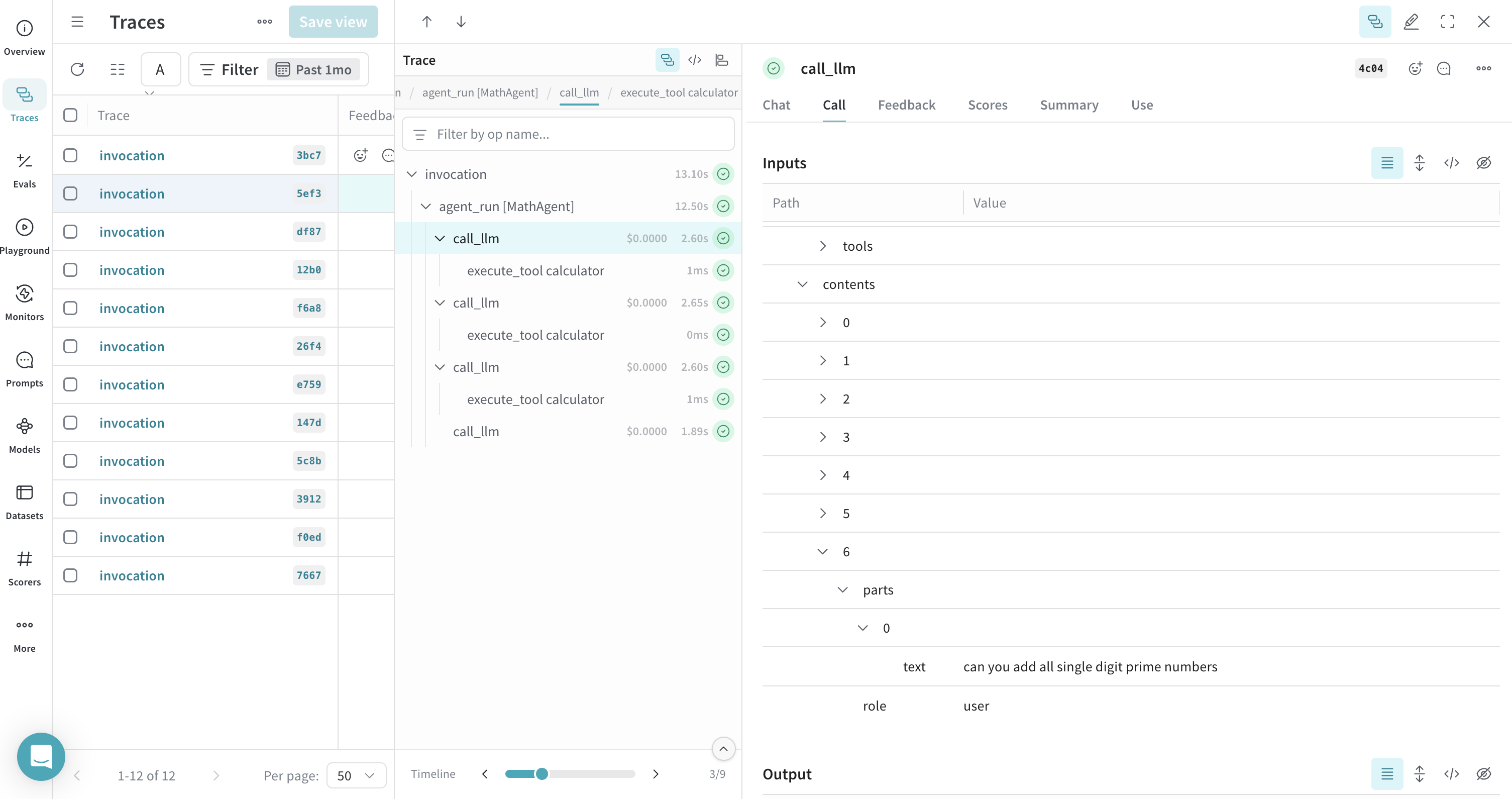
After the run completes, open your W&B project and select Weave > Agents. The trace shows the agent invocation with its model and tool calls, including their inputs, outputs, timing, token usage, and cost when available.
Data and privacy
Weave sends trace data to the W&B service configured by your SDK. Depending on the agent, this data can include prompts, model responses, tool inputs and outputs, and application metadata. Review your security, privacy, and retention requirements before tracing sensitive workloads.